Plumbing Apprenticeships in Penrith — Learn the Trade Properly.
Most plumbing apprenticeships around Penrith are four years of hot water swaps and blocked toilets. Ours is not, because most of our work is on industrial sites: manufacturing plants, breweries, brickworks, process water, compressed air, gas trains. You would come out the other end with a trade most plumbers your age do not have. Read the whole page before you get in touch, including the parts that are not a sales pitch.
No Apprentice Positions Open Right Now — Register Your Interest.
We would rather say that plainly than leave a page up that hints otherwise. It changes when the workload changes, and this line is the first thing we update when it does. If you are serious, register your interest anyway: when a spot opens, we look at the people who already put their hand up before we look anywhere else.
What you would actually be doing.
Two halves, and you would see both. Here is the appealing half and the unappealing half, in that order, because you deserve to know both before you commit four years.
Industrial and commercial sites
Peter has spent most of his time since 2000 on plants where one wrong fitting shuts a production line for a shift. That is the work you would be learning on, alongside the domestic jobs.
- Process water and compressed air in stainless, pressure PVC and aluminium, not just copper and PEX.
- Backflow prevention, including the annual compliance testing most plumbers never touch.
- Plant and equipment: pumps, gas trains, safety showers and eyewash, trade waste.
- Reading a site: inductions, safe work method statements, isolation and lock-out, working around live production.
- Paperwork that matters: certificates, test records, as-builts when they are called for.
The Reality: Hard, Physical Work From Day One
Anyone who tells you otherwise is trying to fill a spot rather than train someone. The honest version:
- Early starts. On site by 7am, and site work sometimes means earlier than that.
- Weather happens to you. Roofs in February, trenches in July, and neither waits for a nicer day.
- Blocked drains are part of it. You will deal with things that come back up. Everyone does, for the whole four years and after.
- It is physical. Lifting, kneeling, crawling into places built for nobody. Your body is the tool that has to last.
- Trade school is real study. Four years of it, with assessments, on top of full-time work.
If that list put you off, that is a useful thing to find out now rather than in year two.
What PVS Plumbing Looks for in an Apprentice.
We are a small operation, so whoever we take on works next to Peter every day. That makes character matter more than it would in a big firm. Nobody expects you to arrive knowing how to plumb.
Non-negotiable
- You turn up, on time, every day. This is the single thing that ends most apprenticeships, and it has nothing to do with talent.
- You say when you do not know. On a gas line or a live site, guessing is dangerous. Asking is not weakness, it is the job.
- A driver’s licence, or a clear plan to get one. The work is spread across the Penrith LGA, Western Sydney, the Hawkesbury and the lower mountains.
- You can be spoken to straight. You will be corrected on site, often, and it is not personal. It is how the trade has always worked.
- You are physically up to it. Be honest with yourself about this one.
We will teach you
- Every tool. If you have never held one, that is fine. Nobody is born knowing how to run a threading machine.
- Every material. Copper, stainless, PE, HDPE, PEX, PVC, aluminium, and which belongs where.
- How to talk to customers. Explaining a fault to a worried homeowner is a skill, and it is worth money.
- How to price and scope a job. Most apprentices finish with no idea how a job is quoted. That is a gap we would rather close.
- How to work on a live site without becoming the reason a shift stops.
A broom operator. Small business cuts both ways: there is nowhere to park someone out of the way, so you would be on the tools early, doing real work with your name attached to it. That is more pressure than a big firm, and it is also why our apprentices came out the other side able to run a job.
The apprentices we have trained are the same people we now bring on as subcontractors when a job needs a second set of hands. That is the actual test of whether an apprenticeship worked.
How a Plumbing Apprenticeship Works in NSW.
This part is the same whoever you end up working for, so it is worth understanding before you approach anyone. Sources are linked at the bottom of the page.
You need an employer before you can start
This is the part that surprises people. You do not enrol at TAFE and then go looking for work. An apprenticeship is a job first, and the training follows. That is why finding someone to take you on is the hard step, and why approaching several places is sensible rather than rude.
You and the employer sign a Training Contract
A formal agreement registered with Training Services NSW, usually set up with help from an Apprenticeship Network Provider. It sets out the qualification, the hours and the obligations both ways. There is a probation period at the start, which protects you as much as it protects the employer.
You work full time and study alongside it
The qualification is the Certificate III in Plumbing (CPC32420), delivered by TAFE NSW or another registered training organisation, typically over around four years. You are paid the whole time, at apprentice rates that step up each year. Your employer coaches and supervises you and follows a Training Plan.
Then you get licensed, and the ceiling lifts
Finishing the Certificate III is not the end of it. To work unsupervised and contract in your own right you need a licence from Building Commission NSW, and gasfitting is its own endorsement on top. That licence is what turns a qualification into a career you control.
Apprenticeship training in NSW is currently fee-free. The NSW Government is paying the course cost for government-funded apprenticeships, so neither you nor your employer pays upfront training fees, for training commenced before 30 June 2027. Places are limited, so confirm availability with the training provider rather than assuming.
Put plainly: you get paid to learn a trade, and the qualification itself does not put you in debt. There are not many careers where both of those are true.
Direct Employment or Group Training Organisation — Two Ways Into Your Apprenticeship.
We are open to both, and which one suits depends as much on us as on you. Worth understanding the difference, because most people have never heard of the second one.
| Route | How it works | What it means for you |
|---|---|---|
| Employed directly by PVS | We sign the Training Contract, employ you, and carry your wages, entitlements and records for the full term. | Simplest to understand, and you are our apprentice start to finish. It also asks us to commit to four straight years of steady work, which is a big call for a small business. |
| Hosted through a Group Training Organisation | A GTO employs you and handles wages, entitlements and employment records. PVS hosts you, supervises you, and pays the GTO for your time. | You still work with us day to day and learn the same trade. If our workload dips, the GTO can place you elsewhere instead of your apprenticeship stopping, so it is often safer for you, not just easier for us. |
Group Training Organisations exist specifically for small and specialised employers who cannot commit to the whole Training Contract period. That describes us honestly, so we would rather put it on the page than pretend otherwise. NSW also runs a placement service for apprentices whose employment has ended part way through, so if you are already partly qualified and looking to finish, say so when you write.
Common Questions About Plumbing Apprenticeships in Penrith, NSW.
In our experience the parent does most of the research on a decision like this, so these are for you rather than for them. Straight answers, including the ones that are not in our favour.
Is this a real career, or a dead end?
It is a licensed trade with a legal barrier to entry, which is exactly what makes it durable. Plumbing cannot be done offshore, and it cannot legally be done by someone unlicensed. After the four years your child can work for anyone, contract for themselves, or run a business. Peter did the same apprenticeship and now owns this one.
Will they be paid, or is this unpaid work experience?
Paid from day one, as an employee with proper entitlements. Apprentice rates start low and step up each year of the term. It is not big money in year one, and it is also not a debt: the training itself is currently fee-free in NSW for training commenced before 30 June 2027.
Is a small business riskier than a big firm?
Honestly, both ways. In a small business they get far more hands-on work and far more contact with the person who actually knows the trade, instead of being one of twelve apprentices. The risk is that a small business is more exposed to a quiet patch. That is exactly the risk a group training arrangement removes, which is why we are open to it.
Is it safe?
The work involves gas, confined spaces, roofs, trenches and live industrial sites, so it is not risk-free and we will not pretend otherwise. It is managed with supervision, site inductions, safe work method statements and isolation procedures, and an apprentice works under the supervision of a licensed plumber throughout. Nobody gets sent to do something on their own that they are not ready for.
How to Apply for a Plumbing Apprenticeship with PVS.
There is no vacancy today, so there is no form and no portal. There is an inbox, and a short list of things that will make you stand out in it.
- Email, do not ring. Peter is on the tools most of the day, and a call gets a worse hearing than an email he can read properly that evening. Use the button and it fills in the subject line for you.
- Write it yourself. A few honest paragraphs from you beat a polished template every time, and the two are easy to tell apart. Spelling is not the test. Effort is.
- Tell us where you are up to. Still at school, finished, already started an apprenticeship somewhere else, or coming from another job entirely. All of those are fine, and each one changes the conversation.
- Tell us how you would get to work. Licence, learners, public transport, a parent who can drop you. We are asking about reliability, not judging you.
- Say why plumbing, and not just “I am good with my hands”. If you have done any hands-on work at all, paid or not, mention it.
- Attach a resume if you have one. If you do not have one yet, do not let that stop you writing. We would rather have the email.
We read everything, and we keep the good ones on file. We cannot promise a reply to every email, because there is no vacancy and Peter is one person. What we can say is that when a spot does open, the people who already wrote in are the first ones we go back to.
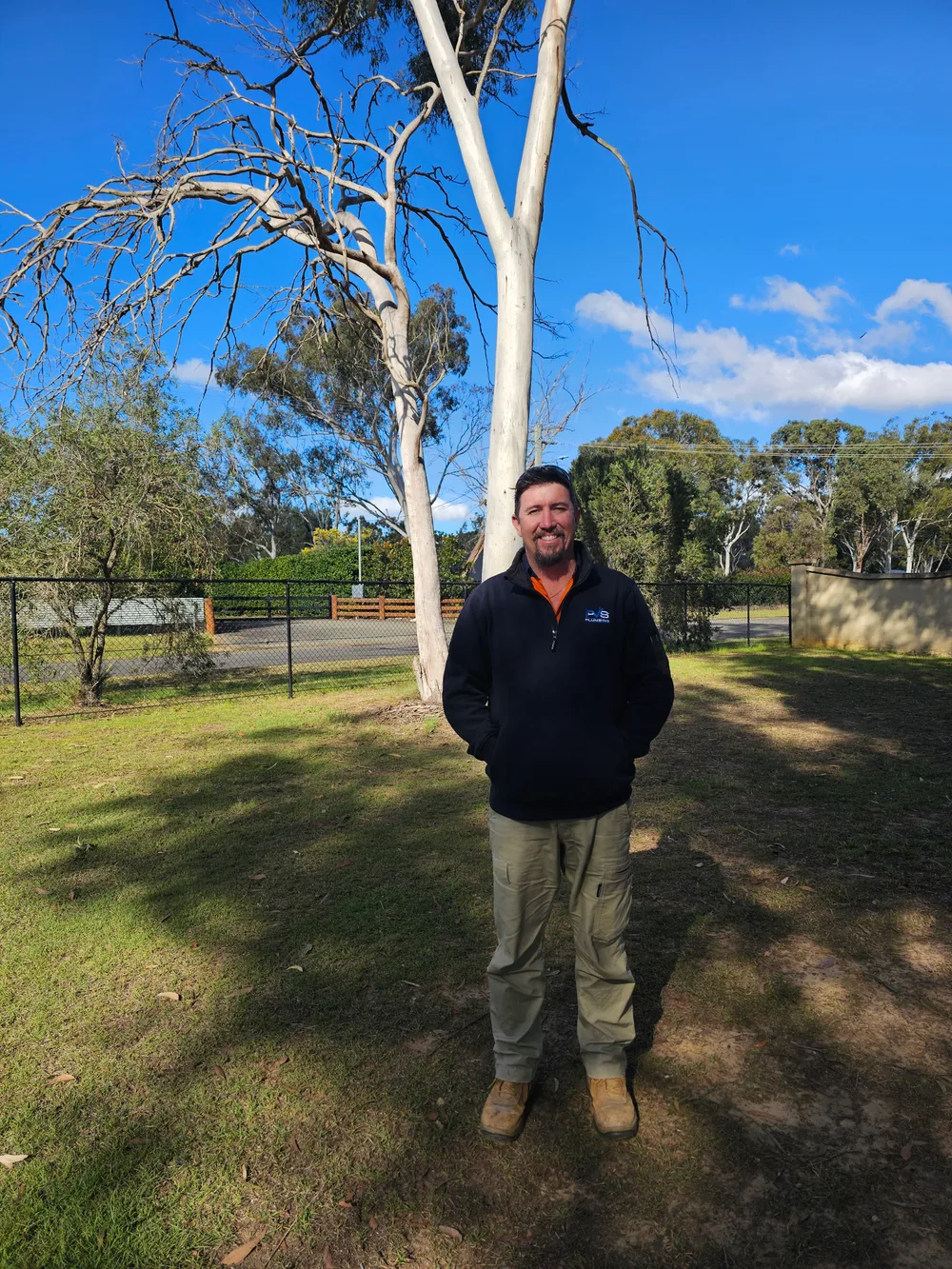
“I would rather train one person properly than have three standing around. If that is the kind of apprenticeship you want, write to me and tell me why.”
Email Peter directlyFrequently Asked Questions — Plumbing Apprenticeships.
How old do I have to be?
Do I need to have started at TAFE first?
I already started an apprenticeship somewhere else. Can I finish it with you?
What does an apprentice actually get paid?
Do you take work experience students?
I am a qualified plumber, not an apprentice. Do you use subcontractors?
The pathway, fee and group training facts above come from the NSW Government. Rules and funding dates change, so check the current version rather than taking a plumber’s word for it.
Written 20 August 2026 and correct against NSW Government guidance on that date. General information about the apprenticeship pathway in NSW, not personal or legal advice. Award rates, funding arrangements and eligibility are set by others and change. The status board at the top of this page is the authority on whether we are taking anyone on.
Register Your Interest in a Plumbing Apprenticeship with PVS.
When a spot opens, the people already on file are the first ones we go back to. A few honest paragraphs is all it takes, and it costs you nothing but the time to write it.